
Hype Adjacency
Exploring adjacent innovation alongside the Gartner Hype Cycle

One concept I’ve enjoyed exploring lately is the concept of the “adjacent possible.” This posits that there are a set of ideas, new innovations and possibilities, achievable from the current state of affairs. In addition to this, I’ve been reflecting on Gartner’s Hype Cycle. This cycle presents stages through which emerging technologies progress, from initial excitement and inflated expectations to eventual maturity and widespread adoption.
Now imagine a journey where every hype cycle opens up new doors of adjacent possibilities, where every peak and trough can lead to accelerated expansions in technology. In this post, I want to explore how I see these two concepts intertwine and feed additional pathways for innovation and development.
The Adjacent Possible
The adjacent possible refers to potential innovations and opportunities that are achievable from our current state of affairs. It was originally coined by Stuart Kauffman. At the heart of it, it suggests that some advancements are beyond immediate reach, that there is a close-by frontier of reasonable developments that may be reached or, at least, explored with some effort. What’s more, is that the idea behind the Adjacent Possible is that innovation may occur through smaller steps that continually open new possible pathways. It advocates for the idea that progress is driven by what is achievable given our existing knowledge, resources, or technology.
I think it’s also important to note that this idea was originally presented through a lens of biology, but is applicable far more broadly.
The Gartner Hype Cycle
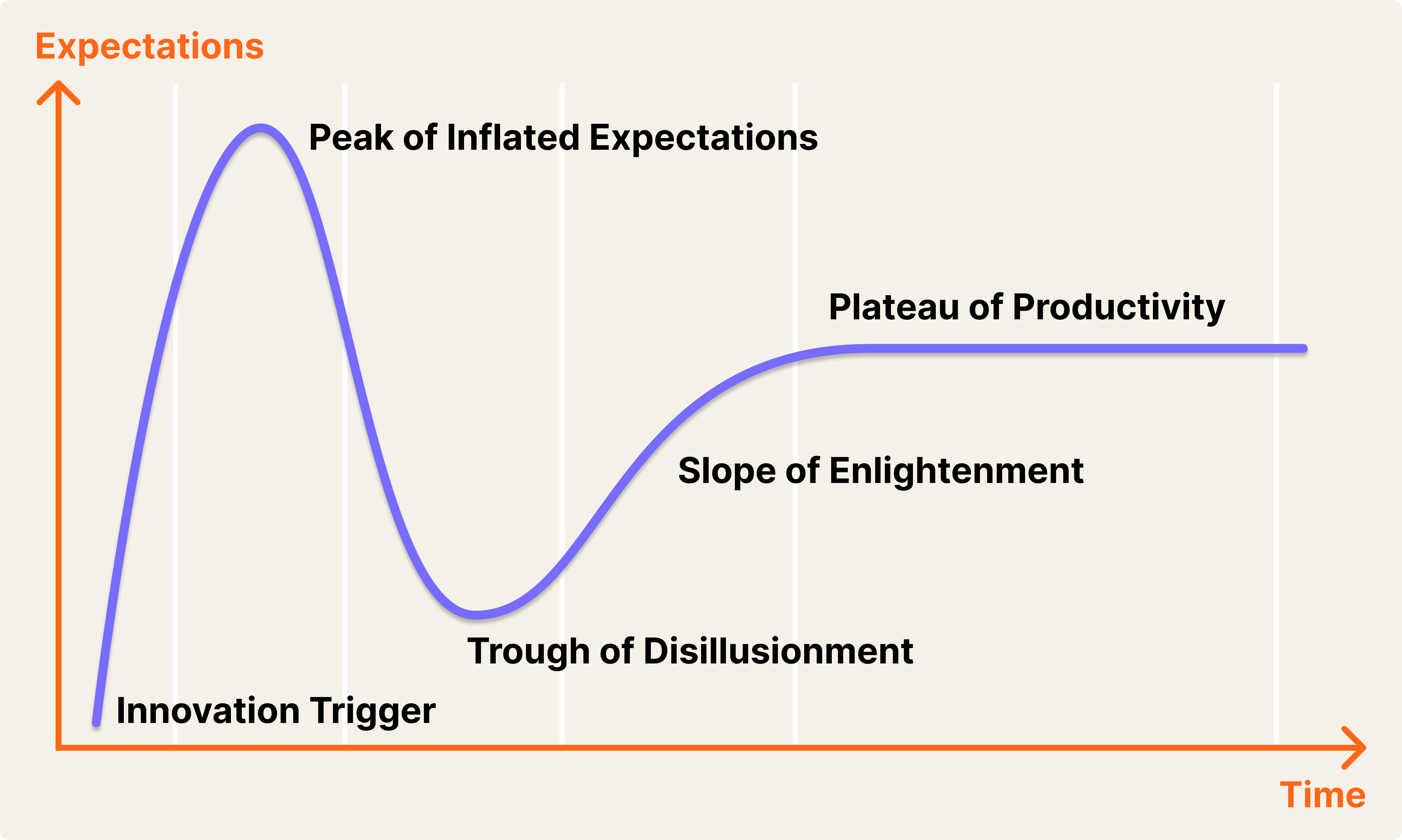
The Gartner Hype Cycle illustrates the stages of expectations for specific technologies over time. Created by the advisory firm Gartner, it consists of a curve that charts the maturity, perceptions, and mind share of a technology from its inception in the public consciousness to its widespread adoption and integration into everyday use.
The cycle typically begins with an "Innovation Trigger," marking the emergence of a new technology or innovation often highlighted by media interest. This is then followed by a steep rise in wider consciousness know as the “Peak of Inflated Expectations,” where excitement and hype produce countless positive as well as negative stories. Subsequently, the curve descends into the "Trough of Disillusionment," as reality sets in, and the technology fails to meet the inflated expectations. Through gradual learning and practical applications, the technology eventually proceeds through the "Slope of Enlightenment" and, finally, the "Plateau of Productivity," where its true value and potential become more widely understood, realized, and embraced.
Enlightening Adjacency
The convergence of these two, in my opinion, is most potent during the “Slope of Enlightenment” phase of the hype cycle. It’s at this point that the technology going through the hype cycle has begun to “settle in” to everyday life. The reality of exploring the adjacent possible with this new technology is most concrete during this phase. That’s not to say exploring adjacency isn’t present elsewhere.
That said, the "Innovation Trigger" and "Peak of Inflated Expectations" phases also present opportunities to explore the adjacent possible as new ideas and possibilities emerge, pushing the boundaries of what is currently achievable. Innovators and early adopters will be actively exploring the adjacent possible, experimenting with different approaches and applications of the technology to capitalize on its perceived potential. At this early stage, though, that potential may be murky and rife with failure, especially from the perspective of a wider audience.
I’d argue it's during the "Slope of Enlightenment" that the adjacent possible truly becomes the most pronounced and tangible. As the cycle settles in, as early adopters refuse to give up, this phase yields a deeper understanding of the technology's capabilities and limitations, leading to more practical and informed exploration of adjacent opportunities. As real-world applications emerge and successes are demonstrated, the adjacent possible expands, offering new pathways for innovation and development.
Resources
https://www.gartner.com/en/research/methodologies/gartner-hype-cycle
https://en.wikipedia.org/wiki/Gartner_hype_cycle
https://fs.blog/gates-law
https://www.ted.com/talks/stuart_kauffman_the_adjacent_possible_and_how_it_explains_human_innovation